Fleet depots & workshops
Charge the fleet overnight and keep the workshop running.
Nohmad Edge CSMS is on-site EV charging management for fleet depots and workshops. It measures what your compressors, hoists and welders draw on each phase and gives the chargers only what is left, re-sharing every 10 seconds. It runs on a box in your switchroom, works with any OCPP 1.6J smart-charging AC charger, and keeps charging when the internet drops.
- re-sharing around workshop loads
- 10 s
- RFID session records
- Per driver
- wall display for the yard
- Status grid
- no internet needed
- Offline
Illustrative depot
10 vans · 100 A per phase
Each phase, overnight
65 A for vans
Overnight load 25 A · Vans 65 A · Margin 10 A
All 10 vans charging from 9 pm
6.5 A each
About 4.5 kW per van: 33 kWh in about 7.4 h of a 10 h window
- Needed tonight
- 330kWh
- Available, 9 pm to 7 am
- 450kWh
Unmanaged, ten 11 kW chargers starting together would ask for 160 A per phase.
What you're up against
What makes depot and workshop charging hard?
Rarely the chargers. It is the supply, the shift and the bill.
The vans have to be ready by morning.
A van that misses its charge misses its run. You need to know the night's energy fits inside the hours the fleet is parked, every night, not just on average.
One modest supply, shared with the workshop.
Hoists, compressors and welders come and go all day. A fixed EV allowance has to assume they all run at once, which leaves the chargers very little, and a bigger connection is slow and costly.
A demand charge that lasts all year.
On capacity-style network tariffs, one afternoon of vans plugging in together inside the peak window can set the charge for the next 12 months.
Locked to a cloud, or to one brand.
If load management lives in someone else's cloud, an outage at 2 am leaves each charger on its last limit or its default profile, and neither follows the workshop's load until the link returns. And a workshop sees every make of car, so a single-brand system ages badly.
How Edge CSMS handles it
How does Edge CSMS fit charging around the workshop?
One industrial PC in the switchroom runs the chargers and the load management together, measuring the site's real load rather than guessing it.
Gives EVs only what's left
A meter on the main switchboard reads every phase every second. Every 10 seconds, Edge CSMS takes the supply limit, subtracts what the hoists, compressors, welders and lights are drawing, and shares the rest between the chargers. Limits cascade from the incoming supply through each switchboard to each charger, per phase where meters and charger phase mappings exist.Shares the night fairly
Capacity is shared at equal current (the default) or equal power across the bays charging. Below a 6 A floor a bay pauses or holds at the floor, by policy. An idle-bay policy decides what a finished vehicle that's still plugged in gets: held at the floor, parked at 0 A, or its session ended after an idle time.Puts priority vehicles first
Pause, resume or cap any charger from the console, so the shared supply flows to the vehicle that has to leave first. Force-stop, site hold and a site-wide emergency drop are there too. There is no departure-time scheduling: your operator sets the priorities.Caps the site's kW demand
Optional instantaneous and rolling-average kW caps on the incoming supply trim EV charging to keep the site under a ceiling you set. They work in kW, not kVA, need a meter reporting voltage at the incomer, and are not aligned to your network's demand windows.Records every session by driver
RFID allow-lists of up to 10,000 tags per charger, managed through the API today. Every session records kWh, RFID tag, charger and bay, exportable to CSV and filterable by tag, bay and date: operational records for reimbursement and your FBT paperwork.Works with mixed brands
Any AC charger that implements OCPP 1.6J smart charging, single- or three-phase. Unknown chargers wait in Pending until an operator accepts them. There is no published compatibility list yet, and DC charger support is on the roadmap.
Priorities, from the console
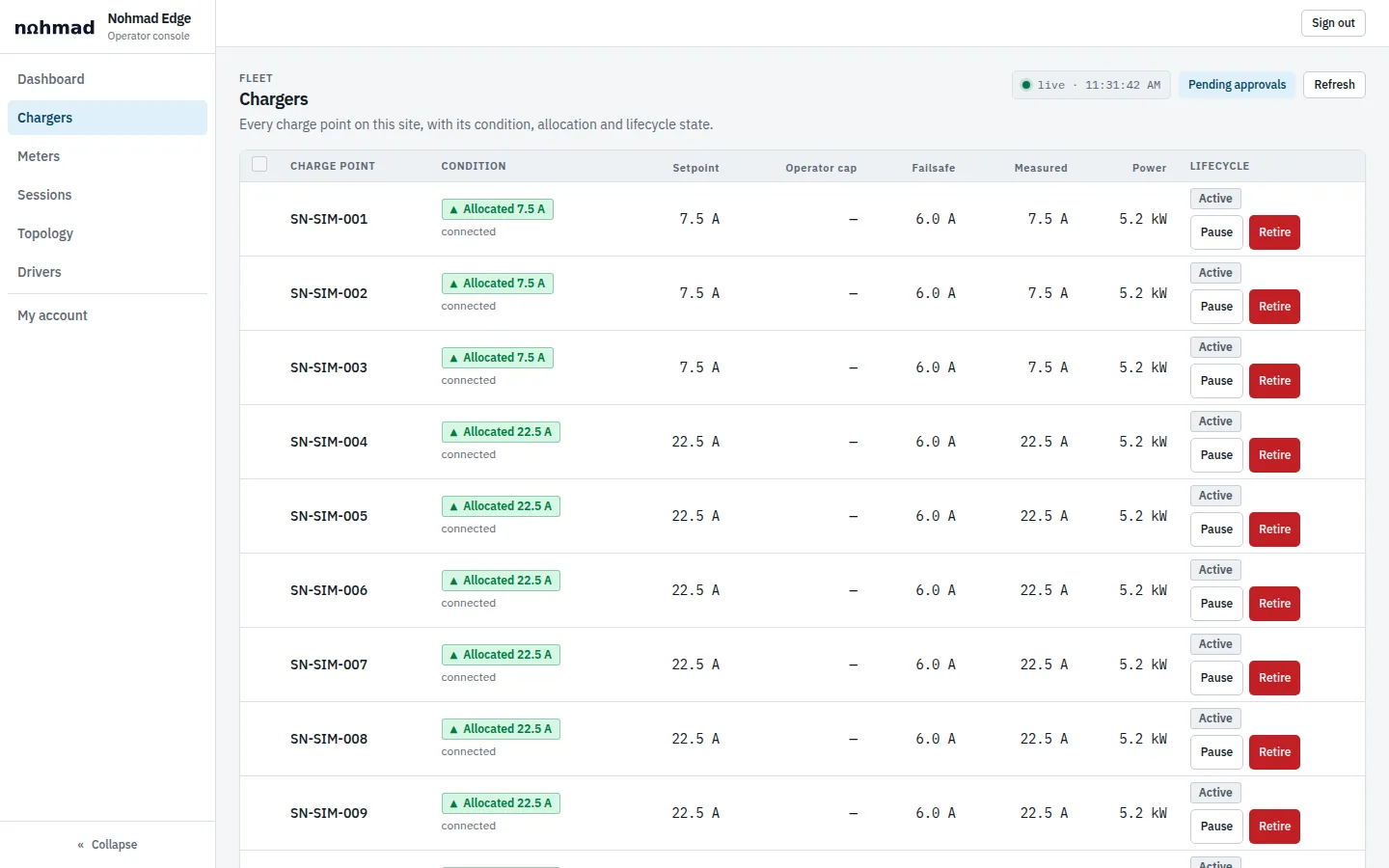
The Chargers screen shows every charger's setpoint, operator cap, fail-safe current, measured current and power, with pause and resume beside each one. Unknown chargers wait in Pending until someone accepts them.
Offline by design
What happens when the internet drops at 2 am?
Nothing changes. Edge CSMS runs on an industrial PC in your switchroom with no cloud dependency, so load management, RFID authorisation and session records carry on, and the data stays on the box.
- The internet drops
- Nothing changes. There is no cloud in the loop, and the data stays on the box.
- A charger loses contact with the box
- New sessions on it run at its offline fallback limit, 10 A by default. A session already running keeps its last allocation.
- The meter goes quiet for 60 s (the default)
- Chargers drop to their safe current, new sessions start only at safe current, and a critical alarm is raised.
- A charger ignores its limit
- It is clamped to 0 A, probed in steps, then reset (soft, then hard), with alarms along the way.
- A charger goes silent for 5 minutes
- Its bay is clamped to 0 A and a critical alarm is raised.
- Someone needs to know
- 42 live alarm types, sent as JSON webhooks to your service desk.
Load management sits on top of your protection, never instead of it. Your breakers remain the last line.
A Status grid for the yard
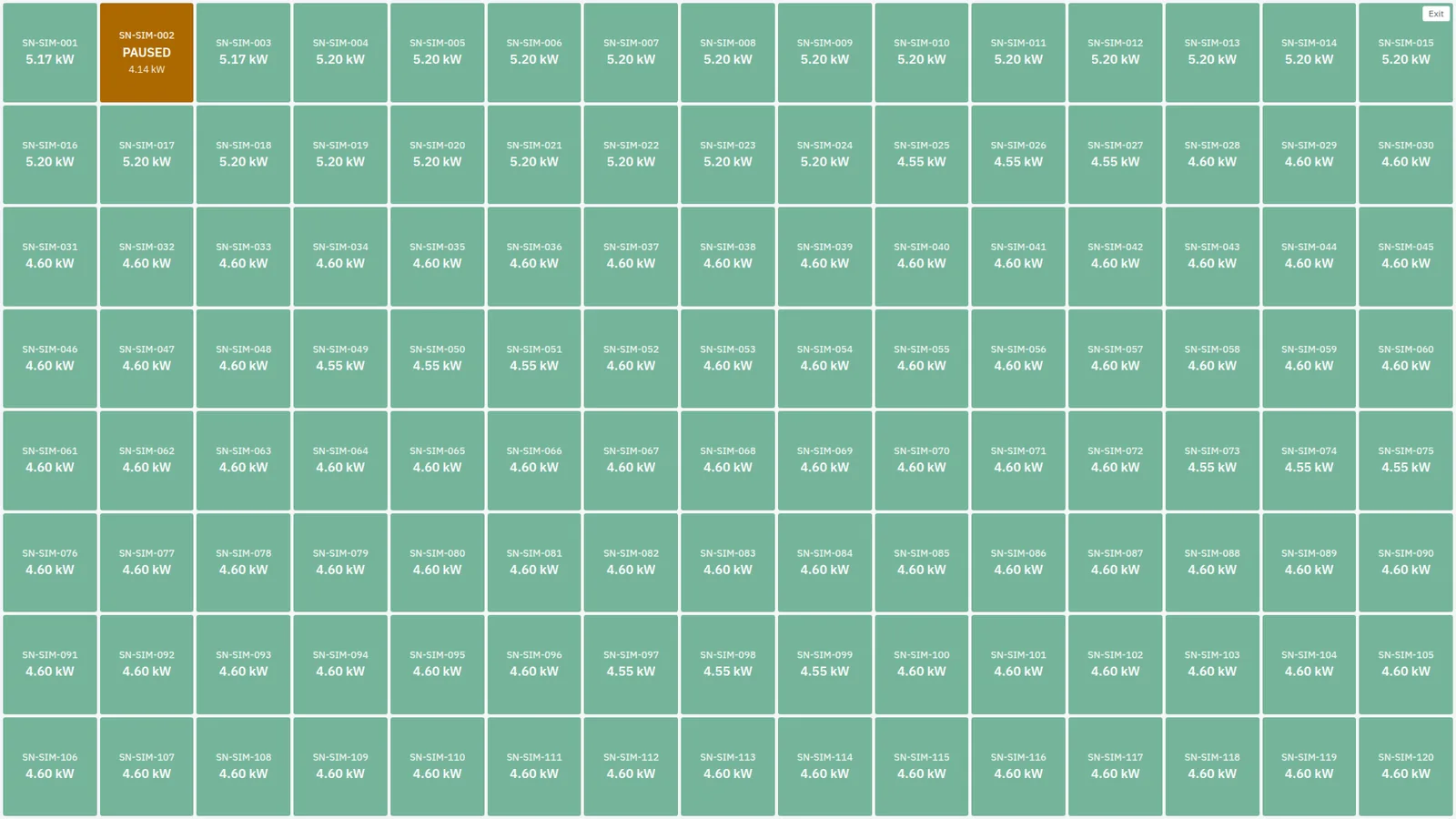
A chrome-less wall display served by the box: a tile for every charger with its power and state, so the first driver in can see which bays are charging and which are paused.
Worked example · illustrative
Can a 100 A supply charge ten vans overnight?
Often, if the chargers are managed. Ten unmanaged 11 kW chargers would ask for 160 A per phase. Shared against measured load, the same ten fit inside 65 A per phase and every van finishes inside the window.
- Supply
- 100 A per phase, three-phase 400 V
- Overnight non-EV load
- 25 A per phase peak: lighting, refrigeration, IT, security
- Margin
- 10 A per phase, leaving 65 A (about 45 kW) for vans
- Fleet
- 10 vans, 100 km a day at 0.30 kWh/km, plus 10 % charging losses: 33 kWh each
- Window
- Parked 9 pm to 7 am: 10 hours
- Chargers
- 11 kW three-phase (16 A), one per van
160A
6.5A
7.4h
36%
| Illustrative depot | Unmanaged, full rate | Managed, shared per phase |
|---|---|---|
| Current asked of the supply | 160 A per phase with all 10 starting | At most 65 A per phase |
| Chargers a static design fits | 4 (64 A) | All 10, sharing the 65 A |
| Each van, all 10 charging | Not possible inside the supply | 6.5 A per phase, about 4.5 kW |
| Time to add 33 kWh | About 3 h, for the 4 that fit | About 7.4 h, inside the 10 h window |
And a workshop on 80 A per phase?
Say the tools peak at 60 A per phase but usually draw about 25 A, and you keep a 5 A margin. A fixed EV allowance has to assume the peak: 15 A per phase for the chargers, all day. Sharing against measured load gives them about 50 A per phase most of the time, pulling back towards 15 A when everything runs.
Motor starts still need that margin. A motor started direct-on-line draws about 5 to 7 times its nominal current while it runs up (MB Drive Services, Direct on-line start (opens in a new tab)). A loop that re-shares every 10 seconds handles sustained loads, not that inrush, so protection coordination stays with your electrical designer.
- Fixed allowance, all day
- 15A
- Shared, most of the day
- ≈ 50A
Illustrative examples only, not designs. Measure, don't assume: the same depot at 2 pm, with the workshop running, may have far less to spare. Maximum demand is determined by your electrical designer under AS/NZS 3000.
Market, tariffs and tax
What else shapes depot charging in Australia?
Each card links its source; all were checked on 23 October 2026. Tariffs and tax rules change, so confirm the current position with your network, retailer or adviser.
Market · H1 2026
One in four new cars is now an EV
EVs were 25.8 % of new car sales in Australia in the first half of 2026, while electric trucks and vans were still below 1 % of their markets. Many fleets are planning their first depot chargers now, and the supply connection is usually where the plan stalls.
Network tariffs
One afternoon can set a year's demand charge
Capacity-style network tariffs charge on your highest demand in a set window, looked back over 12 months. Ausgrid uses the highest half-hour kVA between 3 pm and 9 pm on working weekdays; Powercor the highest 15-minute kVA between 7 am and 7 pm on workdays. Vans that return at 4 pm and all start at full rate inside such a window can set the charge for a year.
Our maximum demand guide works through the numbers.
Tax · FBT
The electric car exemption, carefully
The ATO says private use of an eligible electric car, and the electricity to charge it, is exempt from fringe benefits tax, but the benefit is still reportable. The exemption covers cars, defined as designed to carry less than one tonne and fewer than nine passengers, so check each van; plug-in hybrids stopped qualifying from 1 April 2025. Keep records of how you worked out electricity costs, and let your tax adviser decide how to use them.
Maximum demand · AS/NZS 3000
Load management as a design tool
AS/NZS 3000 clause 2.2.2 lets maximum demand be determined by calculation, assessment, measurement or limitation, and the Electric Vehicle Council's guidance treats load management as creating a definite duty cycle under the assessment method, with protective devices as the backstop. That is your electrical designer's call and responsibility, and it is why load management is a design tool, not only an operational one.
What you need on site
Four things in the switchroom and the yard.
Edge CSMS uses open protocols at every boundary, so most of the hardware is your choice.
A meter on the main switchboard
Where the workshop and the chargers share a supply. An Algodue UPM209 over Modbus-TCP has a built-in preset (validated against an emulated meter so far), and its Rogowski-coil kit wraps existing cables, which suits a retrofit in a live switchroom. An Eastron SDM630 has a preset too; other Modbus-TCP meters connect through a register map.Ethernet to the chargers
A wired site network links the meter, the chargers, the box and the yard display. Chargers talk to the box over OCPP 1.6J, and nothing needs the internet.OCPP 1.6J smart-charging AC chargers
Single- or three-phase, any brand that implements smart-charging profiles. When a charger connects, Edge CSMS checks it can hold the charging profiles it needs and raises an alarm if it can't.The Edge CSMS box
One industrial PC per site, in the switchroom: designed for a fanless DIN-rail unit running Ubuntu LTS. It serves the console and the Status grid to any browser on the site network.
Who installs it? Your electrical contractor. They design the installation, determine maximum demand and commission Edge CSMS through a 13-stage browser wizard. If they haven't worked with us before, send them to our page for installers.
How a project runs
From first numbers to a working depot.
Share your numbers
Vehicles, daily kilometres, the hours they're parked, the supply rating and any interval data. The capacity calculator gives a first estimate.
Check the site
Your electrician looks at the supply, the switchboards, what else runs on them (compressors, hoists, welders) and the cable routes to the bays.
Design and quote
Your electrician designs the installation and determines maximum demand. We provide documentation and a person to talk to about topology and metering.
Commission
Meter, chargers and box go in. Your electrician models the switchboard tree and its limits in a 13-stage browser wizard, then accepts each charger.
Operate
The Status grid goes on the yard wall, alarms go to your service desk, and session records export to CSV for reimbursement.
Edge CSMS is available for early sites by enquiry. See how Edge CSMS works in detail.
Insights
Related reading
Fleet & workshops
Fleet depot and workshop EV charging on a limited supply
The full guide behind this page: duty-cycle sizing, the worked example, AC or DC, demand tariffs and day-to-day operation.
Maximum demand
Maximum demand and EV charging: what a demand cap is worth
How Australian networks measure demand, why one bad afternoon can set a year's charge, and how to value a cap.
Load management
Hardware-agnostic EV load management: what “OCPP compatible” means
What OCPP 1.6J standardises, what it leaves to each charger, and what to ask before you buy for a mixed fleet.
FAQ
Questions fleet and workshop managers ask
Can a 100 A three-phase supply charge ten vans overnight?
Often, if the chargers are managed. In our illustrative depot, 10 vans each needing 33 kWh over a 10-hour night average 33 kW, about 48 A per phase at 400 V. With 25 A of measured overnight load and a 10 A margin, 65 A per phase is spare: enough for about 13 such vans. Ten unmanaged 11 kW chargers would ask for 160 A per phase.
Will charging trip the main when the compressor starts?
Not from sustained loads. Edge CSMS reads the meter every second and re-shares every 10 seconds, so chargers give way when compressors, hoists and welders run. Starting current is different: a motor started direct-on-line draws about 5 to 7 times its nominal current while it runs up, faster than any 10-second loop. That is what the design margin and your protection are for; load management sits on top of your breakers, never instead of them.
Can charging be recorded per driver?
Yes, at the depot. Give each driver an RFID card and add it to the chargers' allow-lists, up to 10,000 tags per charger, managed through the API today. Every session then records kWh, tag, charger and bay, and exports to CSV filtered by tag, bay and date: raw material for reimbursement and FBT records. Charging at drivers' homes is outside what Edge CSMS sees.
Does it work if the internet drops?
Yes. Edge CSMS runs on an industrial PC on site with no cloud dependency, so load management, RFID authorisation and session records carry on, and the data stays on the box. If a charger loses contact with the box itself, new sessions on it run at an offline fallback limit, 10 A by default, and a session already running keeps its last allocation.
Can Edge CSMS manage DC fast chargers?
Not yet. Edge CSMS manages AC chargers that implement OCPP 1.6J smart charging, single- or three-phase, and DC charger support is on the roadmap. Most overnight depots start with AC anyway: with long dwell times, the vehicle's on-board charger sets the rate and a shared AC supply usually covers the night's energy. Short dwell times or multiple shifts point towards DC.
Can it charge the vans that leave first, first?
Not automatically: Edge CSMS does not schedule by departure time. An operator can cap or pause less urgent bays from the console so the shared supply flows to the vehicle that has to leave first, and an idle-bay policy decides what finished vehicles still plugged in are given. In our illustrative depot, all ten vans finish inside the window with no priorities set.
Is charging fleet EVs at the depot FBT exempt?
The ATO says private use of an eligible electric car, and the electricity to charge it, is exempt from FBT, but the benefit is still reportable. The exemption covers cars, so check each van against the ATO's definition, and plug-in hybrids stopped qualifying from 1 April 2025. Per-driver session records help with the paperwork; your tax adviser decides how to use them.
Send us the depot's numbers.
Vehicles, daily kilometres, the hours they're parked and the supply rating. We'll tell you plainly whether Edge CSMS fits, and what your electrician would need on site.