Apartments & strata
Strata EV charging the whole building can agree on.
Nohmad Edge CSMS is on-site EV charging management for apartment buildings. It measures the building's load on each phase and shares what is left across owners' chargers every 10 seconds, so a car park can add chargers before it adds supply. It records energy per bay for cost recovery and works with any OCPP 1.6J smart-charging AC charger.
- re-sharing between bays
- 10 s
- energy records, CSV export
- Per bay
- any AC smart-charging brand
- OCPP 1.6J
- no internet needed
- On site
Illustrative building
60 bays · 400 A per phase
7 pm, evening peak
70 A spare
Building 290 A · EVs 70 A · margin 40 A, worst phase
10 pm to 7 am, average
190 A spare
Building 170 A · EVs 190 A · margin 40 A, worst phase
- Unmanaged, full rated current
- 6chargers
- Managed, shared per phase
- 60bays
- about 19.7 kWh each a night
What you're up against
What stalls EV charging in a strata building?
Rarely the chargers. It is the same four questions at every committee, usually all at once, with owners on both sides of each.
Do we need a bigger supply?
The first quote counts every charger at full current, and the answer is a supply upgrade: expensive, slow and disruptive, for a car park where only a few owners drive an EV today.
Who pays, and is it fair?
Owners who don't drive an EV won't fund those who do, and light users won't pay what heavy users pay. Without a record of who used what, every levy turns into an argument.
What if the vendor disappears?
Chargers that only talk to one company's cloud tie the building to that company. If the subscription rises or the company goes, the building is left with hardware nobody can manage.
Is it safe, and will it pass a vote?
Owners ask about fire and insurance. The committee needs answers it can defend at a general meeting, and a plan that treats every owner the same way.
How Edge CSMS handles it
How does Edge CSMS share a building's supply fairly?
One industrial PC in the switchroom runs the chargers and the load management together. Here is how it answers each of those questions.
Measures first, then shares
A meter on the main switchboard reads every phase every second. Every 10 seconds, Edge CSMS takes the building's limit, subtracts the measured load of lifts, pumps and apartments, and shares what is left between the cars charging. Each charger's allowance is the tightest limit above it. Limits apply per phase where meters and charger phase mappings exist, otherwise on the worst phase.Fair by rule, not by argument
Capacity is shared at equal current (the default) or equal power. Below a 6 A floor a bay pauses or holds at the floor, by policy. An idle-bay policy decides what a finished car that's still plugged in gets: held at the floor, parked at 0 A, or its session ended after an idle time.Records for cost recovery
Every session records kWh, RFID tag, charger and bay. Export to CSV, filtered by tag, bay and date, for your strata manager or billing provider. Edge CSMS does not bill residents: no tariffs, payments or resident accounts.Owners choose the charger
Any AC charger that implements OCPP 1.6J smart charging, single- or three-phase. Your chargers aren't ours: if the building ever changes management system, point them at another CSMS. There is no published compatibility list yet, so ask us about a model.Runs in the building
One industrial PC in the switchroom runs the chargers and the load management together. It needs no internet connection, nothing runs in a vendor's cloud, and the records stay in the building.Fails safe, on purpose
If the meter goes quiet for 60 seconds (the default), chargers drop to their safe current and a critical alarm is raised. A charger that ignores its limit is clamped to 0 A. Load management sits on top of your protection, never instead of it: breakers remain the last line.
What the building manager sees
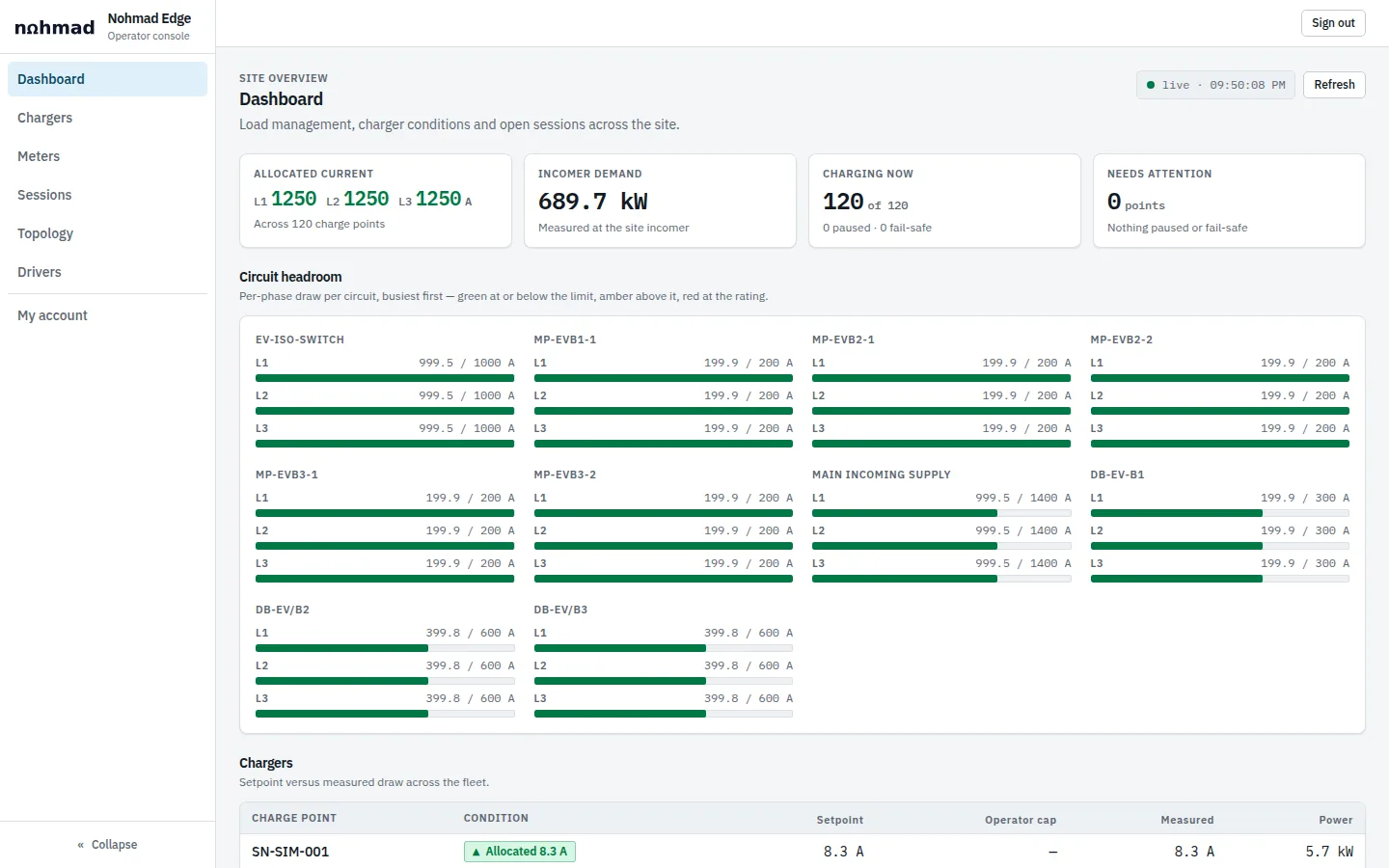
The operator console is served by the box to any browser on the building network: per-phase headroom for every switchboard, each charger's allocation, alarms to acknowledge, and sessions with their energy and CSV export. Alarms can also go to your service desk as webhooks.
Worked example · illustrative
How many EV chargers can a 60-lot building support?
It depends on spare current per phase, not on car spaces. In this illustrative building, counting chargers at full rated current fits 6. Sharing the overnight headroom lets all 60 bays charge, at about 19.7 kWh per car a night.
- Building
- 60 lots, 60 car spaces
- Supply
- Three-phase, 400 A per phase
- Logged demand, worst phase
- 290 A at the evening peak; 170 A average, 10 pm to 7 am
- Margin
- 10 %, leaving 360 A usable per phase
- Chargers
- 7.4 kW single-phase (32 A at 230 V), spread evenly
- Driving
- 40 km a day at 17 kWh per 100 km: 6.8 kWh per car
6chargers
60bays
19.7kWh
35%
| Illustrative building | Unmanaged, full rated current | Managed, shared per phase |
|---|---|---|
| Chargers installed | 6 (2 per phase) | 60 (20 per phase) |
| Current per car overnight | 32 A | 32 A with up to 5 cars per phase; 9.5 A each with all 20 |
| Energy per car over 9 hours | Up to 66 kWh, for 6 cars only | About 19.7 kWh each, all 60 charging |
| At the 7 pm peak | Inside limits by design | 70 A per phase shared: at the 6 A floor, 11 cars per phase charge and the rest pause until load falls |
| Supply upgrade for 60 chargers? | Yes: 60 × 32 A ÷ 3 = 640 A per phase against 70 A spare | Not in this example; your designer confirms |
Illustrative example only, not a design. Real charging varies, so measurement and margin matter more than any rule of thumb. Maximum demand is determined by your electrical designer under AS/NZS 3000.
For your committee
The short version, in five points.
Taking EV charging to a committee meeting or a general meeting? Start here. Each point is expanded on this page and in our strata guide.
The building's supply, not its number of car spaces, limits how many owners can charge.
Measure first: at least 12 months of the building's demand data, as the Electric Vehicle Council's guidance suggests, logged per phase.
Share the spare capacity with load management. AS/NZS 3000's assessment method gives the electrical designer a route to recognise it; the designer decides.
Agree how costs are recovered before the first charger goes in, and get advice before billing anyone per kWh.
Ask for chargers that implement OCPP 1.6J smart charging, so the building, not a vendor, decides who manages them.
Rules and context
What rules apply to EV charging in strata buildings?
Strata law and guidance are changing quickly, state by state. Each card links its source; all were checked on 23 October 2026. Confirm current status with the publisher or your adviser before relying on any of it.
NSW · voting
A lower bar for sustainability infrastructure
EV charging is an express example of sustainability infrastructure under the Strata Schemes Management Act 2015. A special resolution fails if more than 25 % of the value of votes cast are against it; a sustainability infrastructure resolution passes as long as less than 50 % are against. The owners corporation must first weigh the section 132B(1) factors, including running costs, who does the work, ownership and access.
NSW · passed 15 Oct 2026
Right to charge, commencing by proclamation
NSW Parliament passed the Strata Schemes Legislation Amendment (Miscellaneous) Bill 2025 on 15 October 2026. As reported, new section 132D lets an owner install an EV charger on their lot after written notice: the committee has three months to respond, silence counts as no objection, and unreasonable objections can go to NCAT. Section 132E has the owner pay and indemnify the owners corporation.
The sections commence by proclamation; as at 23 October 2026 we have seen no commencement date. A right to install does not create capacity, and a measured plan lets the committee answer every notice the same way.
VIC · August 2026
A government guide for owners corporations
Victoria's Department of Energy, Environment and Climate Action published an EV-ready guide for owners corporations in August 2026. It covers electrical capacity and load management, fair division of costs, billing and suppliers, approvals under the Owners Corporations Act 2006, and insurance and safety. It is guidance, not law.
New buildings · NCC 2022
Clause J9D4: EV-ready car parks
NCC 2022 clause J9D4 requires car parks in new Class 2, 3, 5, 6, 7b, 8 and 9 buildings to provide labelled, EV-only distribution boards. In Class 2 buildings, circuits must support a charger delivering at least 12 kWh between 11 pm and 7 am. Chargers themselves are not required.
Maximum demand · AS/NZS 3000
Load management under the assessment method
AS/NZS 3000 clause 2.2.2 lets maximum demand be determined by calculation, assessment, measurement or limitation. The Electric Vehicle Council's guidance treats a load-management system as creating a definite duty cycle under the assessment method, with protective devices as the limitation backstop. The electrical designer chooses the method and carries the responsibility.
Cost recovery · get advice
Billing per kWh is on-selling electricity
Selling energy normally needs a retailer authorisation. The Australian Energy Regulator lists owners corporations on-selling to residents as exempt selling, with conditions, and Victoria's Essential Services Commission has an exemption for selling electricity to charge EVs. The instrument whose reading sets the price also falls under the National Measurement Institute's trade-measurement rules. Take advice from a strata lawyer or energy adviser before billing per kWh.
Safety · insurance
Fire and insurance questions
The Australian Building Codes Board's 2023 advisory note sets out low-cost risk-mitigation measures for car parks, and the Electric Vehicle Council publishes fire-safety guidance for chargers in buildings. Ask your fire engineer, the fire authority and your insurer what applies to your car park. Load management controls electrical capacity; it is not a fire-safety system.
What you need on site
Four things in the switchroom and car park.
Edge CSMS uses open protocols at every boundary, so most of the hardware is your choice.
A meter on the main switchboard
An Algodue UPM209 over Modbus-TCP has a built-in preset (validated against an emulated meter so far), and its Rogowski-coil kit wraps existing cables, which suits a retrofit in a live switchroom. An Eastron SDM630 has a preset too; other Modbus-TCP meters connect through a register map.Ethernet to the chargers
A wired building network links the meter, the chargers and the Edge CSMS box. Chargers talk to the box over OCPP 1.6J, and nothing needs the internet.OCPP 1.6J smart-charging chargers
Any AC charger that implements smart-charging profiles. When a charger connects, Edge CSMS checks it can hold the charging profiles it needs and raises an alarm if it can't.The Edge CSMS box
One industrial PC per site, in the switchroom: designed for a fanless DIN-rail unit running Ubuntu LTS. It serves the operator console to any browser on the building network.
Who installs it? Your electrical contractor. They design the installation, determine maximum demand and commission Edge CSMS through a 13-stage browser wizard. If they haven't worked with us before, send them to our page for installers.
How a project runs
From first numbers to a working car park.
Share your numbers
Supply rating, number of car spaces, the chargers you have in mind and any demand data. The capacity calculator gives a first estimate.
Check the site
Your electrician looks at the supply, the main switchboard, the boards that would feed the car park and the cable routes.
Design and quote
Your electrician designs the installation and determines maximum demand. We provide documentation and a person to talk to about topology and metering.
Commission
Meter, chargers and box go in. Your electrician models the switchboard tree and sets its limits in a 13-stage browser wizard, then accepts each charger.
Operate
The building manager watches headroom and alarms in the console, and exports session records for cost recovery.
Edge CSMS is available for early sites by enquiry. See how Edge CSMS works in detail.
Insights
Related reading
Apartments & strata
EV charging for apartments and strata: a capacity-first guide
The full plan behind this page: measuring demand, the worked example, cost-recovery models and the rules by state.
Load management
Hardware-agnostic EV load management: what “OCPP compatible” means
What OCPP 1.6J standardises, what it leaves to each charger, and what to ask before owners buy one.
Already on a cloud platform?
OCPP proxy or on-site CSMS? Adding load management to a charging site
How each approach works, what happens when the internet drops, and how to choose.
FAQ
Questions committees ask
Do we need to upgrade our supply to add EV chargers?
Not always. Counting every charger at full rated current uses up spare capacity fast, but AS/NZS 3000 also lets the electrical designer determine maximum demand by assessment or measurement. Measure the building's demand per phase, share the spare capacity with load management, and many buildings can charge residents' cars overnight on the existing supply. Your designer decides, and carries that responsibility.
How do owners pay for the electricity they use?
Most committees choose user-pays. The common models are chargers on each lot's own metered supply, a flat fee, per-kWh recovery from session records, or a provider who bills drivers directly. Edge CSMS records each session's kWh by RFID tag and bay and exports it to CSV for your strata manager or billing provider; it does not bill residents. Billing per kWh is on-selling electricity, so get advice first.
Can owners choose their own charger brand?
Yes, with one condition: the charger must implement OCPP 1.6J smart charging, the open protocol a management system uses to set a charger's current. Edge CSMS works with any AC charger that does, single- or three-phase, and holds each new charger in Pending until an operator accepts it. There is no published compatibility list yet, so check a model with us before owners buy.
What happens if the internet goes down?
Nothing changes. Edge CSMS runs on an industrial PC in the building, so load management, RFID authorisation and session records carry on without an internet connection, and the data stays on site. If the building's meter goes quiet for 60 seconds (the default), chargers drop to their safe current and a critical alarm is raised. Your breakers remain the last line of protection.
Is load management recognised by the wiring rules?
AS/NZS 3000 clause 2.2.2 lets maximum demand be determined by calculation, assessment, measurement or limitation. The Electric Vehicle Council's 2024 guidance treats a load-management system as creating a definite duty cycle under the assessment method, with protective devices as the limitation backstop. The electrical designer chooses the method and carries the responsibility: load management supports the design, it does not replace it.
What does the NSW right-to-charge law mean for our building?
As reported, amendments NSW Parliament passed on 15 October 2026 add section 132D: an owner can give written notice to install an EV charger on their lot, the committee has three months to respond, silence counts as no objection, and unreasonable objections can go to NCAT. The sections commence by proclamation, so check whether they are in force. A measured capacity plan helps the committee answer every notice consistently.
What happens to a car that has finished charging but stays plugged in?
Edge CSMS has an idle-bay policy for that. The operator chooses whether a finished car is held at the 6 A floor, parked at 0 A, or has its session ended after an idle time, so a car left in its bay overnight holds little or none of the capacity other owners' cars could use. The same rule applies to every bay.
Bring us your building's numbers.
Send the supply rating, the number of car spaces and any demand data you have. We'll tell you plainly whether Edge CSMS fits, and what your electrician would need on site.