Commercial & industrial sites
EV charging that stays inside your maximum demand.
Nohmad Edge CSMS is on-site EV charging management for commercial and industrial sites. It reads the meter on your incoming supply every second and gives chargers only the headroom left under your kW demand cap and every switchboard limit, re-shared every 10 seconds. It runs on one industrial PC in your switchroom, with no internet connection required.
- instantaneous or rolling average
- kW caps
- re-allocation
- 10 s
- per-board limits, per phase where mapped
- L1·L2·L3
- no internet needed
- On site
- Site load
- 138.0kW
- Site limit
- 138.0kW
- EV charging
- 36.8kW
- Cars charging
- 18of 18
What you're up against
Someone asked for EV charging. Nobody mentioned the demand charge.
Facility managers inherit the consequences of a charging project: the bill, the switchboard, the network and the next purchase. These are the problems worth solving before the first charger goes in.
One half-hour sets the bill for a year
Several network tariffs charge for your single highest 15- or 30-minute demand in a window, looking back 12 months. One unmanaged evening of charging can set that charge for the next year.The supply upgrade nobody budgeted for
New consumer mains, a bigger main switchboard or network augmentation is the slow, expensive and disruptive way to add chargers. It should be the last option, not the first quote.Chargers share boards with real plant
Chillers, compressors, lifts and process loads come and go all day. A fixed limit set on paper can't see them. A measured one can.Another cloud portal, another network path
Many charging platforms run from the cloud: one more login for the facilities team, and one more route from your operational network to the internet.Chargers the BMS can't see
Your operators watch the BMS. A charging system that can't feed it is one more screen nobody checks at 2 am.A controller that picks your chargers for you
Load management tied to one charger brand decides every future purchase, and makes leaving expensive.
How Edge CSMS handles it
How does Edge CSMS keep EV charging inside a demand cap?
Edge CSMS reads the meters on your incoming supply and your boards, subtracts the measured non-EV load from every limit in the site's electrical tree, and shares what is left across the cars that are charging, per phase, every 10 seconds. Limits reach the chargers as standard OCPP 1.6J smart-charging profiles.
Load management sits on top of your protection, never instead of it. Your breakers remain the last line.
- 01Demand cap
Two kW caps on the incoming supply
An instantaneous kW cap, and a rolling-average kW cap over a window you set in minutes. EV charging gets only the headroom underneath.
- 02Topology
Every board limit, cascading from the incomer
Edge CSMS models your real electrical tree: incomer, switchboards, branches and chargers, each with its own current limit. A charger's allowance is the tightest limit above it.
- 03Per phase
L1, L2 and L3 managed separately
Limits are enforced on each phase where meters and charger phase mappings exist, and on the worst phase where they don't.
- 04Measured load
EVs get what the building leaves
Each budget is the node's limit minus its measured non-EV load. When a chiller or compressor starts, the measured load rises and the EVs' share falls.
- 0510 s
Re-shared every 10 seconds
Meters are read every second by default. Capacity is re-allocated every 10 seconds (configurable 5–15 s), at equal current or equal power.
- 06OCPP 1.6J
Limits through standard smart charging
Limits reach the chargers as OCPP 1.6J SetChargingProfile messages: an open standard, not a proprietary link.
- 07Tick log
Every decision on the record
Each allocation is logged and can be replayed exactly, so you can see why every charger got the current it did.
- 08Fail-safe
Documented behaviour when things fail
If the incomer meter goes quiet for 60 seconds (the default), active chargers drop to their per-charger safe current and a critical alarm is raised.
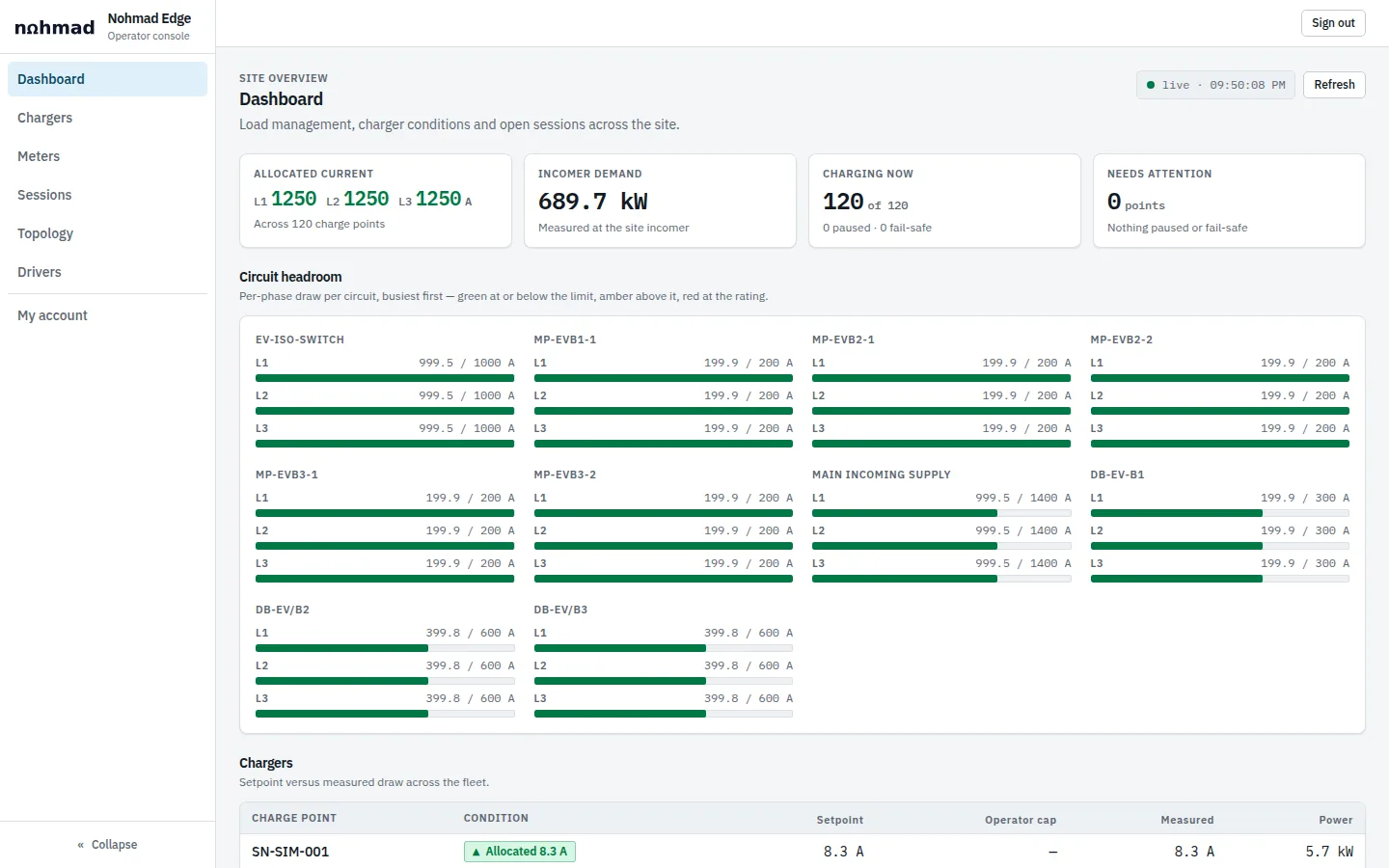
Runs on site
One industrial PC in your switchroom runs the charge-point management system and the load management together. It needs no internet connection and has no cloud dependency, and all data stays on the box, so it can sit on a segregated operational network.
Open at every layer
What connects to Edge CSMS today, and what is on the roadmap?
Edge CSMS uses open protocols at every boundary: OCPP 1.6J to the chargers, Modbus-TCP to the meters, and webhooks, an API and CSV for the data. Here is exactly where the line between built and planned sits.
- Meters over Modbus-TCP: a built-in Algodue UPM209 preset (validated against an emulated meter so far); the Algodue UPM309 and other Modbus-TCP meters through a configurable register map; an Eastron SDM630 preset. Shelly Pro 3EM over MQTT.
- Alarm webhooks (JSON) to your service desk, from 42 live alarm types.
- A REST API with self-service API keys. The read API is documented in OpenAPI.
- CSV exports of session records: kWh, RFID tag, charger and bay.
- A Modbus-TCP server, so your BMS or EMS can read site state and write caps.
- MQTT telemetry publishing.
- OCPP 2.0.1.
- An optional AU-region cloud uplink for multi-site visibility.
Roadmap items have no dates yet.
Network tariffs
How do Australian networks charge for maximum demand?
Many business network tariffs charge for your highest average demand in a 15- or 30-minute interval inside a time window, and some look back over the previous 12 months. One bad evening sets the charge for a year.
Ausgrid's 3–9 pm window covers the hours when vehicles return and staff head home. Powercor's 7 am–7 pm window covers the working day. Ten 22 kW chargers that start together add 220 kW in one step.
A short burst is averaged across the whole interval, but charging sessions are rarely short: a car taking 30 kWh at 22 kW charges for about 82 minutes.
| AusgridPeak capacity charge | Powercor12-month rolling demand, large business | |
|---|---|---|
| Measured in | kVA (apparent power) | kVA (apparent power) |
| Interval | 30 minutes | 15 minutes |
| Window | 3 pm–9 pm, working weekdays | 7 am–7 pm, workdays |
| Look-back | Previous 12 months | Prior 12 months |
| Priced in | c/kVA/day | $/kVA/month |
Sources, checked 23 October 2026: Ausgrid 2026–27 pricing proposal and Powercor 2026/27 Pricing, 7 May 2026, section 2.5, both published by the Australian Energy Regulator. Other networks differ, and definitions change every pricing year, so check your own tariff. The AER publishes every network's pricing proposal.
The value
What is a demand cap worth?
A demand cap is worth the demand charge it avoids plus the supply upgrade it defers. The first part is arithmetic from your own tariff: demand rate × kVA avoided × 12 months. We publish no “typical” rate, because none holds across networks.
A site on a kVA capacity tariff has a building peak of 180 kVA in the tariff window, at a power factor of 0.9. It plans ten 22 kW chargers, which draw at close to unity power factor.
- Building peak in the tariff window
- 180 kVA
- 162 kW + 78.5 kVAr (power factor 0.9)
- Unmanaged, with ten 22 kW chargers
- 390 kVA
- √((162 + 220)² + 78.5²), EVs near unity
- Chosen target
- 230 kVA
- Building peak + 50 kVA for EVs
- kW cap to set
- 196 kW
- 230 × 0.9 × (1 − 0.05) = 196.65 kW
- Check
- ≤ 217.8 kVA
- 196 kW ÷ 0.9 if the whole site sat at 0.9; ≈ 211 kVA with EVs near unity
- Peak avoided
- 160 kVA
- 390 − 230
- At a hypothetical $10.00 per kVA per month
- $19,200 a year
- 160 kVA × $10.00 × 12
The cap has a cost, so size it
At the building's peak, the cars in this example share 196 − 162 = 34 kW. Overnight, if the building drops to 100 kW, the same cap leaves 96 kW for EVs, or 864 kWh over 9 hours. Check that vehicles still get the energy they need.
Run your own numbersThe bigger prize is often the supply
If a cap keeps the site's design maximum demand inside the existing connection, you may defer or avoid new consumer mains, a larger main switchboard or network augmentation. Those costs depend entirely on your site and network, so get a quote rather than trust a rule of thumb.
AS/NZS 3000 clause 2.2.2 allows maximum demand to be determined by calculation, assessment, measurement or limitation. Electric Vehicle Council guidance (2024) treats load management as creating a definite duty cycle under the assessment method, with protective devices as the backstop. Your designer makes the call.
Building management
Will Edge CSMS work with our BMS?
Not through a BMS protocol yet, but the two can work side by side today. The robust arrangement is for the BMS to supervise and the on-site controller to control. The per-phase loop belongs close to the chargers, where it knows each charger's phase and whether it accepted its last limit, and keeps working when the link to the BMS head end doesn't.
- 01Today
Autonomous
Edge CSMS enforces the demand cap and board limits set at commissioning, on its own. The BMS doesn't need to be in the control loop, so charging keeps to its limits if the link to the BMS drops.
- 02Today, with limits
The BMS reads
Alarms go out as JSON webhooks to your service desk or anything that accepts one, and the REST API and CSV exports carry the data. Your BMS can also read the incomer meter directly, if the meter accepts a second Modbus client.
- 03On the roadmap
The BMS writes a cap
The BMS reads site state and writes a site cap over Modbus-TCP, and Edge CSMS turns it into per-charger, per-phase limits. This needs the Modbus-TCP server, which is on the roadmap and not built.
Edge CSMS does not speak BACnet. A BACnet BMS can read the site meter through a Modbus gateway.
Read the BMS integration guideOn site
What do you need on site?
A meter at the incomer, chargers with OCPP smart charging, an Ethernet path and one industrial PC, plus the numbers your electrical designer works from.
A meter on the incoming supply
Reporting voltage and current per phase over Modbus-TCP: an Algodue UPM209 (built-in preset, validated against an emulated meter so far), a UPM309 or another Modbus-TCP meter through a register map. Rogowski-coil versions wrap existing cables, which suits retrofits in live switchrooms.
Meters on the boards you want to limit
Or virtual meters for boards without one, derived from what is metered beneath them and attested at commissioning.
Chargers with OCPP 1.6J smart charging
Any AC charger that implements OCPP 1.6J smart-charging profiles, single- or three-phase, from any brand.
Ethernet to the switchroom
A wired network path from the meters and chargers to the Edge CSMS box. No internet connection is needed.
One industrial PC
Edge CSMS is designed for a fanless DIN-rail industrial PC (N100-class, 8–16 GB RAM, NVMe, 2× Ethernet) running Ubuntu LTS.
Your numbers and your designer
Interval data or a logger reading of today's peak, your network tariff, and an electrical designer to determine maximum demand under AS/NZS 3000.
How does a project run?
- 01
Send us the numbers
Supply rating, interval data or a logger reading, your network tariff, the board schedule and the chargers you have in mind.
- 02
Design the limits
Your electrical designer sets the board limits and the demand cap. We work through the topology and the metering with them.
- 03
Install and commission
Your electrical contractor installs the meters, chargers and box, then commissions the site in a 13-stage browser wizard.
- 04
Observe, then enforce
New installs run meter plausibility checks in observe mode first. Once the readings check out, enforcement is switched on.
- 05
Operate
Your team runs the site from the operator console, in a browser on the site network, with alarms going to your service desk.
Edge CSMS is available for early sites by enquiry. Briefing an electrical contractor or consultant? Show them what commissioning involves, or read the Edge CSMS overview.
Insights
Read the engineering behind it.
Maximum demand
Maximum demand and EV charging: what a demand cap is worth
How networks measure demand, kW versus kVA, and how to set and value a cap.
BMS integration
EV charger BMS integration: Modbus, MQTT and BACnet in practice
Who controls what, register maps and word order, a points list and OT security.
Architecture
OCPP proxy or on-site CSMS? Adding load management to a charging site
How each works at message level, and what happens when the internet drops.
FAQ
Questions facility managers ask.
More in the full FAQ.
Can EV chargers increase our demand charges?
Yes, when cars charge inside your network's demand window. Charger power adds up quickly: ten 22 kW chargers starting together add 220 kW. If that lands on top of the building's own peak, billed demand rises, and on a rolling 12-month tariff it can stay on the bill for a year. A demand cap holds EV charging inside the headroom the building leaves.
Does Edge CSMS cap kVA or kW?
kW. Edge CSMS has an instantaneous kW cap and a rolling-average kW cap on the incoming supply. It assumes a power factor of about 1, needs a meter reporting voltage at the incomer, and does not align to the network's fixed 15- or 30-minute intervals or produce demand-charge reports. If your network bills kVA, set the kW cap below your kVA target: kVA target × worst power factor × (1 − margin).
Can our BMS see EV charging data?
Not through a BMS protocol yet, but the two can work side by side today. Edge CSMS sends alarms as JSON webhooks, has a REST API with self-service API keys and exports session records to CSV. Your BMS can also read the incomer meter directly if the meter accepts a second Modbus client. A Modbus-TCP server for BMS reads and cap writes, and MQTT publishing, are on the roadmap. Edge CSMS does not speak BACnet.
Does Edge CSMS need an internet connection?
No. Edge CSMS runs on one industrial PC at your site, with no cloud dependency, and all its data stays on the box. If your internet connection drops, nothing changes: metering, load management and the operator console carry on.
What happens if the site meter fails?
If the incomer meter stops reporting for 60 seconds (the default), the site enters fail-safe: active chargers drop to their per-charger safe current, new sessions start only at safe current, and a critical alarm is raised. A meter that reads less than the EV load beneath it, such as one with a dead CT, is flagged implausible and treated as dark when plausibility enforcement is on. Breakers remain the last line of protection.
Can we keep our existing chargers?
If they implement OCPP 1.6J smart-charging profiles, they can connect to Edge CSMS as their management system, whatever the brand, single- or three-phase. There is no published compatibility list yet, so send us the models and we'll tell you what has been tested. Keeping an existing cloud CSMS alongside Edge CSMS (a proxy mode) is on the roadmap.
Does load management count under AS/NZS 3000 maximum demand?
AS/NZS 3000 clause 2.2.2 allows maximum demand to be determined by calculation, assessment, measurement or limitation. Electric Vehicle Council guidance treats a load-management system as creating a definite duty cycle under the assessment method, with protective devices as the limitation backstop. Your electrical designer chooses the method and carries the responsibility.
Send us your supply rating and your tariff.
Add the board schedule and the chargers you have in mind. We'll tell you plainly whether a demand cap fits your site, what it would hold, and what you'd need on site.