On-site EV charging management
Charge more cars on the power you already have.
Nohmad Edge CSMS measures your building's load and shares what's left across every charger, per phase, every ten seconds. Any OCPP 1.6J smart-charging AC charger, no internet required. And for drivers, Nohmad Go.
- re-allocation
- 10 s
- per-phase limits, where mapped
- L1·L2·L3
- any AC smart-charging brand
- OCPP 1.6J
- no internet needed
- On site
- Site load
- 138.0kW
- Site limit
- 138.0kW
- EV charging
- 36.8kW
- Cars charging
- 18of 18
The problem
The supply is the bottleneck.
Every site with more than a couple of cars runs into the same limit: the incoming supply. A building sized for lifts, pumps and apartments was never sized for thirty cars charging at once, and a supply upgrade is the expensive, slow and disruptive way out.
But a building's load moves through the day, and so does its spare capacity. Measure the real load, share what is left, and a site can add chargers before it adds amps.
25.8%
Source: Electric Vehicle Council, State of EVs 2026, reported by the CommBank newsroom (30 Sep 2026)
2.2.2clause
10s
How it works
Measure. Share. Enforce.
One industrial PC in your switchroom runs the charging network and the load management together: an OCPP 1.6J charge-point management system and a per-phase allocation engine on the same box.
- 01Meter poll · 1 s
Measure
A meter on the main switchboard reads every phase every second: an Algodue UPM209 over Modbus-TCP (built-in preset, validated against an emulated meter so far), or another supported meter. Boards without their own meter can be modelled as virtual meters.
- 02Allocation · 10 s
Share
Every 10 seconds, each board's limit minus its measured non-EV load (lifts, pumps, apartments) is shared across the cars charging beneath it, at equal current or equal power. A charger gets the tightest limit above it. Limits apply per phase where meters and charger phase mappings exist, otherwise on the worst phase.
- 03OCPP 1.6J smart charging
Enforce
Limits reach each charger as standard OCPP 1.6J charging profiles. A charger that ignores its limit is clamped, and every allocation is logged so it can be replayed exactly.
Solutions
For sites where many cars share one supply.
The engine is the same everywhere. What changes is the job it does for you.
Apartments & strata
Give owners charging on the supply the building already has, with per-bay energy records your strata manager can use for cost recovery.Fleet & workshops
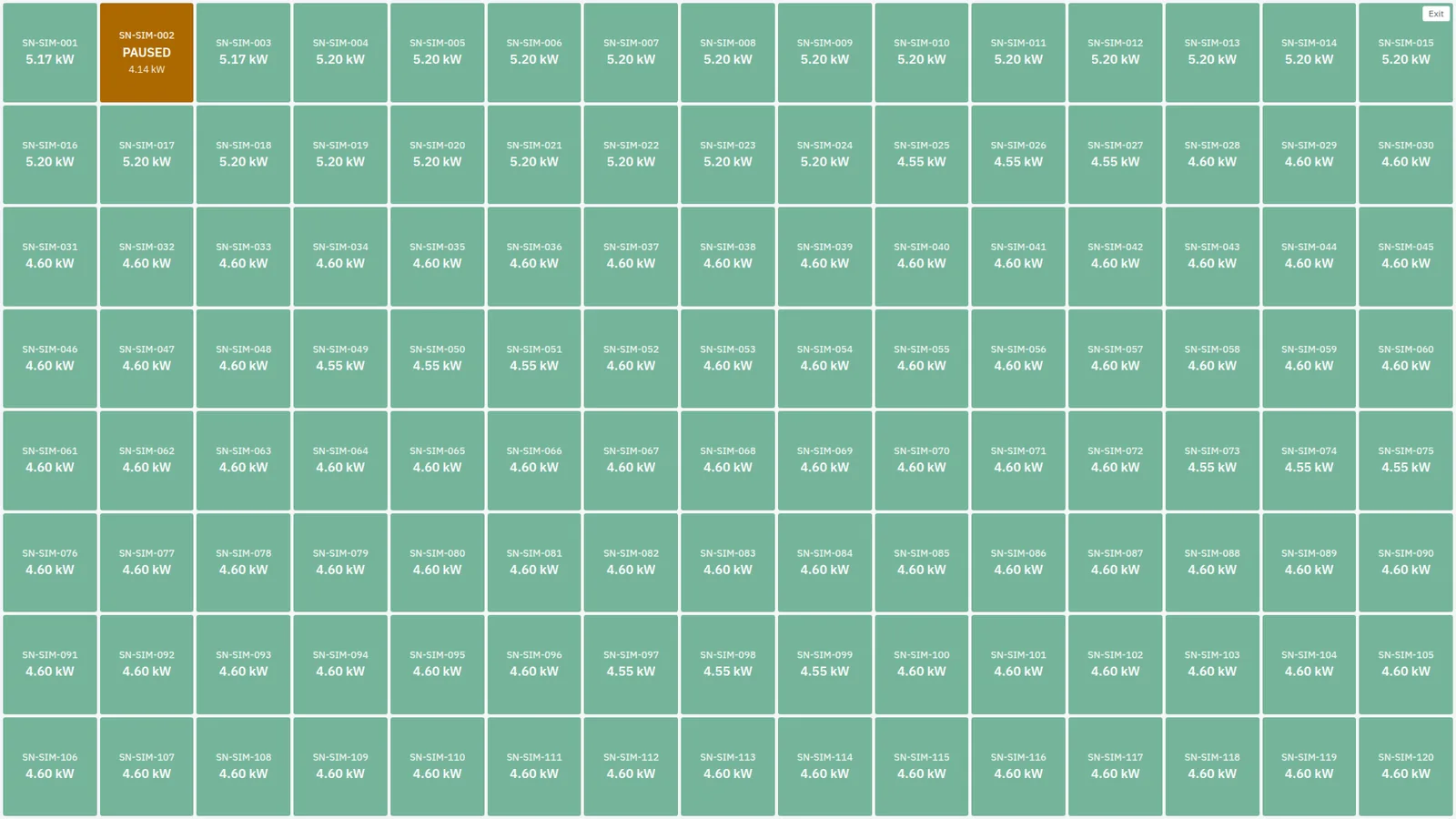
Charge vehicles alongside hoists, compressors and welders, with no cloud in the loop and a Status grid on the depot wall.Commercial & industrial
Hold EV charging inside a kW demand cap on the incomer (metered voltage needed) and every switchboard limit beneath it, with the data kept on site.Installers & consultants
Commission in a 13-stage browser wizard, model the real switchboard tree, and design to documented fail-safe behaviour.
Fails safe, on purpose
Every failure has a documented answer.
Meters go quiet, chargers misbehave and links drop. Edge CSMS has a defined response to each, and none of them depends on the internet.
Load management sits on top of your protection, never instead of it. Your breakers remain the last line.
What happens when…
Everything working
The site meter reports every second, and every 10 seconds Edge CSMS shares the capacity that is left across the cars that are charging. Pick a failure to see what the site does.
Open at every layer
No lock-in at the charger, the meter or the data.
Edge CSMS uses open protocols at every boundary, so you choose the hardware and keep the records.
Your chargers aren't ours.
- Any AC charger that implements OCPP 1.6J smart charging, single- or three-phase.
- Unknown chargers wait in Pending until an operator approves them.
- Leave whenever you like: point the chargers at another CSMS.
- No published compatibility list yet. Ask us about your model.
Read the meter you choose.
- Algodue UPM209: built-in preset over Modbus-TCP, validated against an emulated meter so far.
- Algodue UPM309 and any other Modbus-TCP meter, through a configurable register map.
- Eastron SDM630: built-in preset. Shelly Pro 3EM: over MQTT.
- Rogowski coils wrap existing cables, which suits retrofits in live switchrooms.
Your data stays on your premises.
- Session records (kWh, RFID tag, charger, bay) exported to CSV.
- Alarm webhooks (JSON) to your service desk.
- A REST API with self-service API keys.
- On the roadmap: OCPP 2.0.1 and a Modbus-TCP server for your BMS.
Operator console
The whole site, at a glance.
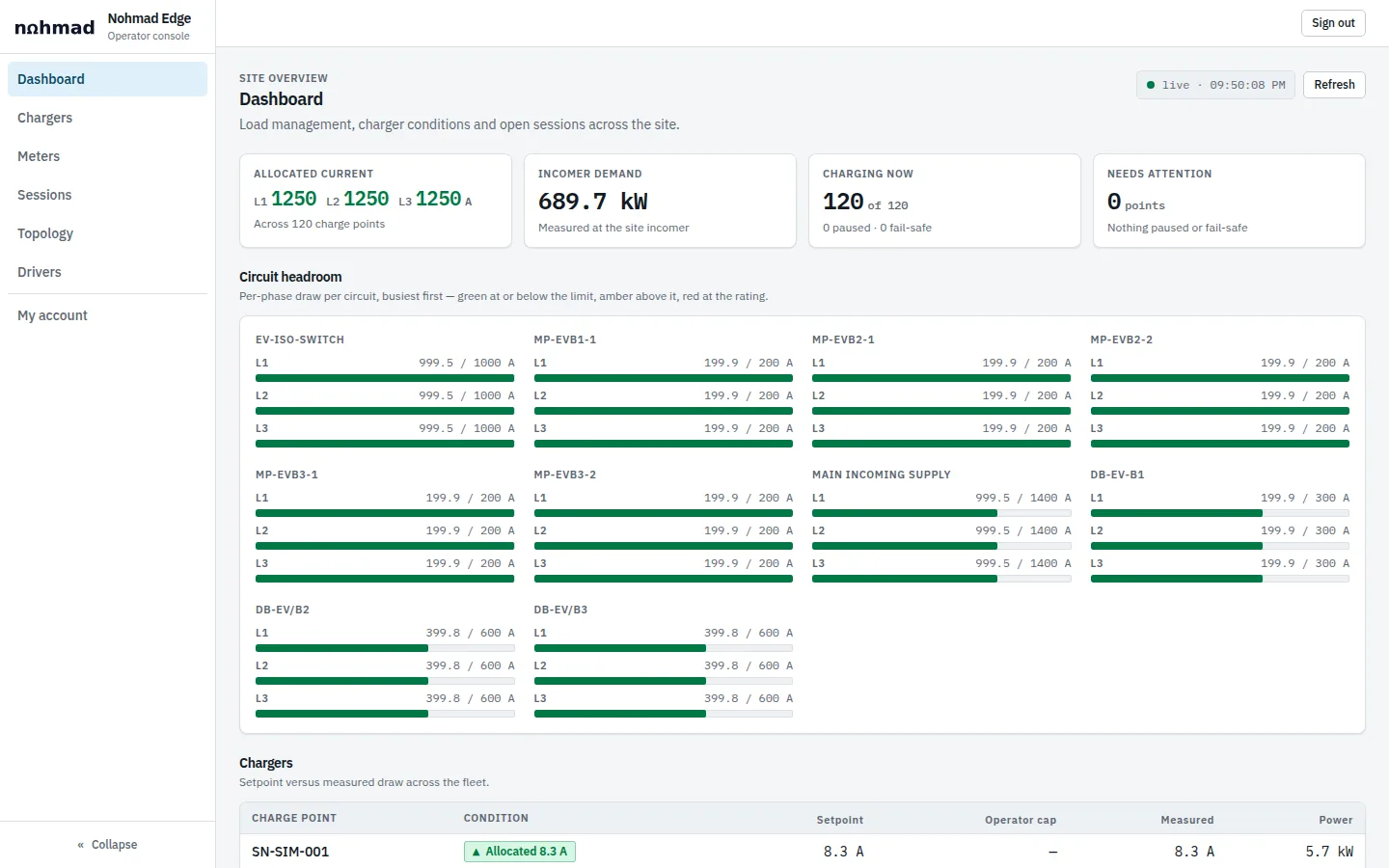
Served by the box to any browser on the site network: per-phase headroom for every board, chargers, meters, alarms, sessions with CSV export, a topology editor, and a Status grid for the depot wall.
Status grid · wall display
For drivers · on sale now
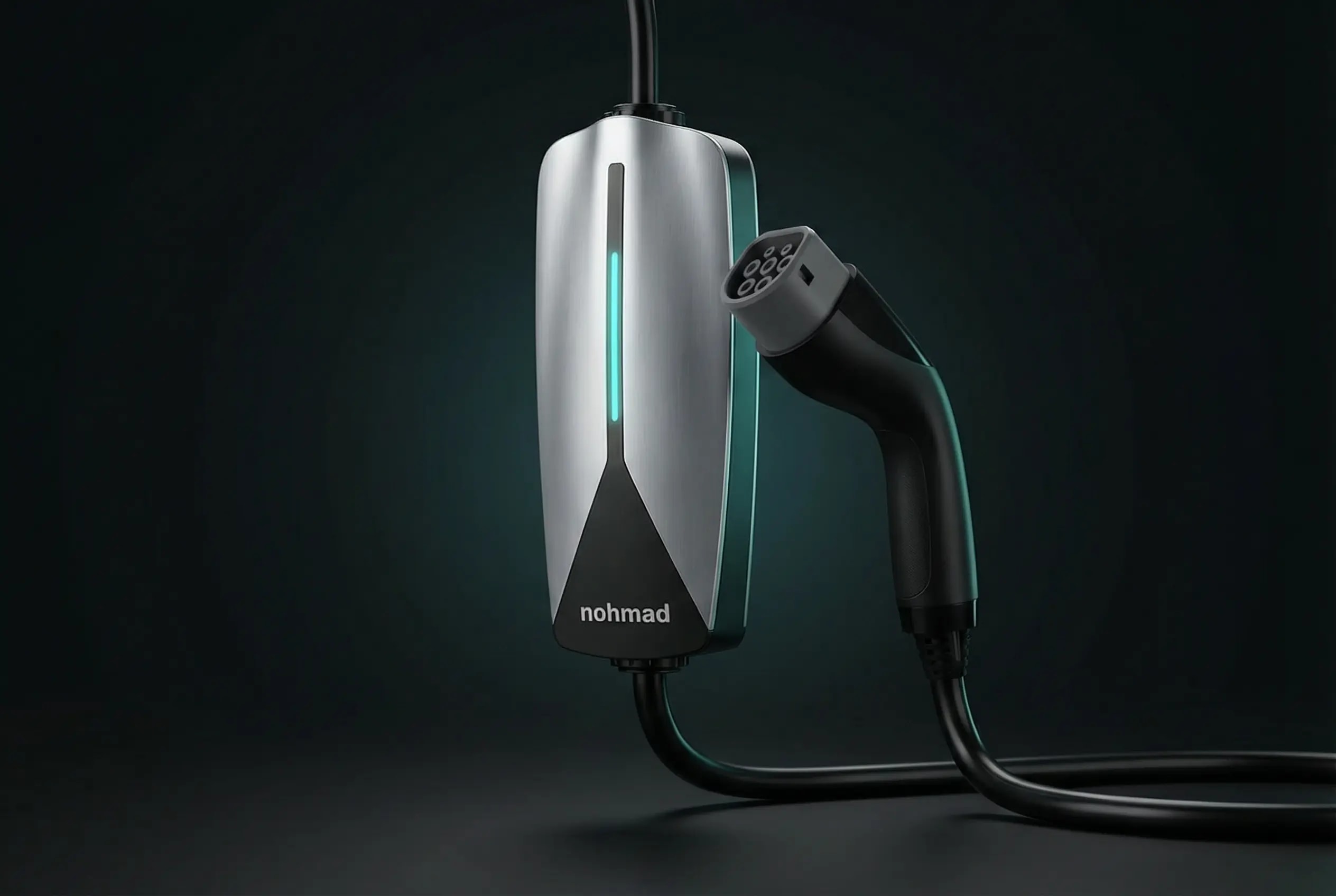
Nohmad Go, the portable charger you can buy today.
A 10 A portable EV charger for the car you already drive. Bluetooth and Wi-Fi, the EasyCharging app for your session history, and it keeps charging without Wi-Fi.
- Power
- Up to 2.3 kW (10 A)
- Connector
- Type 2
- Supply lead
- Fixed 10 A wall plug
- Connectivity
- Bluetooth + Wi-Fi
- App
- EasyCharging
- Without Wi-Fi
- Still charges
Insights
Engineering notes for site owners.
Apartments & strata
EV charging for apartments and strata: a capacity-first guide
Why the building's supply, not the charger, decides how many owners can charge, and how to plan around it.
Demand & tariffs
Maximum demand and EV charging: what a demand cap is worth
How network capacity charges are set, and what holding EV load under a cap changes.
Load management
Hardware-agnostic EV load management: what “OCPP compatible” means
The smart-charging features a charger needs before any load manager can control it, and how to check.
Every site starts with its numbers.
Send us the supply rating, the number of bays and the chargers you have in mind. We'll tell you plainly whether Edge CSMS fits, and what you'd need on site.